Tanzania safari planning guide
The Wildebeest Migration Guide
Africa’s Greatest Living Movement Across the Serengeti–Mara Ecosystem
The Wildebeest Migration Images

Quick Safari Highlights
Field Notes and Safari Context
Africa’s Greatest Living Movement Across the Serengeti–Mara Ecosystem The wildebeest migration is one of the most extraordinary natural events on Earth. It is often described as a living system rather than a simple movement of animals because it never truly begins or ends. Instead, it is a continuous cycle of survival that unfolds across the plains of Tanzania and Kenya throughout the year. Over a million herbivores move together across vast distances, responding to rain, fresh grass growth, and changing environmental conditions.
The Core Species Behind the Migration At the center of this movement is the Blue wildebeest, a hardy and highly adaptable grazer that forms the backbone of the entire migration. These animals are joined by large numbers of zebras and gazelles, creating one of the most concentrated wildlife systems in the world. What makes the migration so remarkable is not only the number of animals involved, but the way different species depend on each other to survive.
How the Migration System Works The migration takes place within the Serengeti–Mara ecosystem, a massive landscape that stretches from northern Tanzania into southern Kenya. This ecosystem is shaped by rainfall patterns rather than fixed routes. When rain falls in one area, fresh grass quickly grows, attracting grazing animals. As those grasses are eaten or dry out, the herds move again in search of new grazing grounds. This constant movement creates a slow, flowing cycle across the landscape.
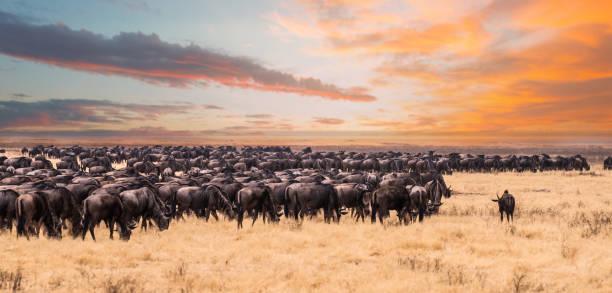
Calving Season in the Southern Plains One of the most important phases of the migration occurs between December and March in the southern Serengeti and Ndutu plains. During this time, the herds gather in enormous numbers on short grass plains enriched by volcanic soils. The grass here is especially nutritious, making it ideal for calving. Thousands of wildebeest calves are born within a short period, often within weeks of each other. This timing is crucial because it ensures that newborns have access to food- rich conditions, giving them the best chance of survival. However, this abundance also attracts predators, turning the plains into a dramatic survival zone.
Movement Toward the West and Central Serengeti As the southern plains begin to dry out between April and June, the herds gradually move northward and westward. This movement is not sudden but slow and responsive to changing conditions. The animals spread across the central and western Serengeti, following patches of fresh grazing. During this stage, the migration becomes more dispersed, but the movement never stops. Rivers such as the Grumeti become important obstacles, where crocodiles lie in wait for crossing herds.
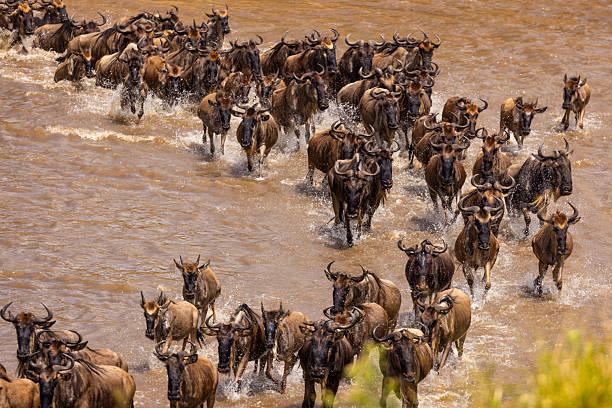
The Northern Serengeti and Maasai Mara Phase Between July and October, the migration reaches its most famous stage in the northern Serengeti and Maasai Mara. This is when river crossings take place, especially at the Mara River. Thousands of wildebeest gather at the riverbanks, often hesitating before entering the water. When they finally cross, the scene becomes chaotic and intense, with strong currents and predators such as crocodiles taking advantage of the situation. This moment is one of the most dramatic wildlife events in Africa, where survival is uncertain and every crossing carries risk.
Return to the Southern Serengeti As November approaches, short rains begin to fall in the southern Serengeti. This triggers the beginning of the return journey. The herds slowly move back south, following fresh grass growth. This return completes the circular pattern of the migration, but it is important to understand that the movement is never fully complete. At any given time, different groups are in different stages of the cycle, maintaining constant motion across the ecosystem.
Survival in Numbers The behavior of wildebeest during migration is deeply tied to survival through numbers. Moving in massive herds provides protection because predators find it difficult to target individual animals. Their constant movement, vocal communication, and tight grouping increase their chances of survival in a dangerous environment filled with lions, hyenas, and other predators. Their strength comes not from speed or size but from unity and endurance.
Ecological Importance of the Migration The migration is not only important for wildebeest but also for the entire ecosystem. As they graze, they shape the grasslands by preventing overgrowth and encouraging fresh growth cycles. Their movement also helps distribute nutrients across vast areas, supporting other grazers such as zebras and gazelles. In this way, wildebeest act as ecological engineers, maintaining balance across the savannah.
Safari Experience of the Migration For safari travelers, witnessing the migration is a deeply immersive experience. It is the sound of thousands of hooves moving across open plains, the sight of endless herds stretching toward the horizon, and the tension of river crossings where survival hangs in the balance. Every moment feels unpredictable because the migration itself is always changing.
Conclusion The wildebeest migration is a powerful expression of nature’s rhythm. It is shaped by rain, driven by instinct, and sustained by millions of years of evolution. It remains one of the most remarkable natural systems on Earth, showing how deeply life is connected to seasonal cycles and survival in the African wilderness.
How The Wildebeest Migration Fits Into a Tanzania Safari
The Wildebeest Migration matters because a great Tanzania safari is not only a list of sightings. It is a sequence of landscapes, seasons, guide decisions, comfort choices, and small field moments that shape how the journey feels. This Tanzania safari planning guide keeps the supplied notes intact and expands them into practical planning advice for travelers comparing routes, timing, accommodation, photography, and guiding style.
Travelers planning a safari should use this guide to understand tradeoffs before choosing dates, budget, comfort level, and route pace. The best safari is the one that matches the guest’s real expectations, not only the most famous itinerary name.
Best Safari Conditions and Viewing Strategy
Field success depends on timing, patience, and interpretation. Early morning gives cooler light, more movement, and better photography. Late afternoon can be excellent for relaxed behavior and softer color. Midday still has value when guests understand shade, water, thermals, migration pressure, or the comfort rhythm of a longer safari day.
- Travel with a guide who can explain habitat, not only identify the subject.
- Keep binoculars or a camera ready before the vehicle stops.
- Watch behavior first, then confirm details such as shape, markings, tracks, calls, or movement.
- Give sightings time. The best moment often happens after the first quick look.
Planning With Tanview Safaris
Tanview Safaris can shape this topic into a route that matches the traveler’s interest. A wildlife-first guest may want slower game drives and more time in open habitats. A photography guest may prefer flexible mornings and better light. A family may need shorter drive sections, clear meal timing, and guides who explain the bush in a warm, patient way. A premium safari may combine stronger guiding with carefully chosen lodges or tented camps that make the day feel calm instead of rushed.
For a stronger plan, connect this guide with Safari Smart Tours, Tanzania Safari Guide, Birdwatching Guide, and Enquiry Now. Those internal resources help turn research into a route, budget, season choice, and booking conversation.
Responsible Safari Notes
Responsible travel protects the experience that visitors come to see. Keep a respectful distance, avoid pressuring guides to disturb wildlife, never feed animals, and treat sensitive habitats carefully. Ethical viewing also improves the quality of the sighting: relaxed wildlife behaves naturally, photographs look better, and the guide can explain the scene without rushing.
How to Combine This With a Wider Route
Most travelers get the best value when this topic is not treated as a stand-alone idea, but as part of a wider route. A northern Tanzania safari can combine Tarangire, Lake Manyara, Ngorongoro, Serengeti, Arusha, village experiences, waterfalls, cultural stops, and specialist wildlife interests in one smooth plan. The right order matters because it affects drive time, fatigue, photography light, and how naturally the trip builds from arrival to the final day.
When guests contact Tanview Safaris, the most useful details are travel month, number of days, comfort level, special interests, mobility needs, and whether the trip should feel adventurous, quiet, family-friendly, romantic, or photography-led. With those details, the team can recommend which experiences deserve a full day, which work best as a short stop, and which should be avoided in the wrong season.
This is also where honest planning helps most. Some experiences look simple on paper but depend on road condition, recent weather, local access, daylight, and how much energy guests have after previous safari days. A well-built itinerary leaves enough breathing room for the experience to feel memorable instead of squeezed between transfers.
Questions to Ask Before You Travel
- Which park, route, or lodge area gives the strongest chance for this interest?
- How much time should be allowed so the experience does not feel rushed?
- What season gives the best balance of weather, wildlife, cost, and comfort?
- Which guide skills, vehicle setup, and accommodation style will improve the day?
FAQ About The Wildebeest Migration
Is The Wildebeest Migration useful when planning a Tanzania safari?
Yes. This guide gives travelers a focused way to understand the topic before choosing dates, routes, guiding style, and the pace of the safari.
Can Tanview Safaris include this interest in a custom itinerary?
Yes. Guests can mention this interest during the enquiry stage so the team can suggest suitable parks, timing, lodges, and drive structure.
Does this guide include the supplied PDF information?
Yes. The article uses the supplied notes and images, then adds practical Tanzania safari context so the page is helpful for both readers and search engines.
What should I ask before booking?
Ask about the best season, realistic viewing chances, drive length, guide expertise, photography needs, accommodation style, and how this topic fits with the wider safari route.